WPC Decking vs Wood Decking: Which Is Better for Outdoor Use?
12th August, 2026WPC Decking vs Wood Decking: Which Is Better for Outdoor Use?
Choosing the right decking material affects more than the appearance of an outdoor space. It also determines how the deck responds to rain, humidity, sunlight, stains, daily foot traffic, and ongoing maintenance.
Natural wood remains popular for its authentic grain and warm character. WPC decking, also called wood-plastic composite decking, is designed to deliver a similar wood-inspired look with improved resistance to many common outdoor challenges.
So, when comparing WPC decking vs wood decking, which is better? For most projects where water resistance, low maintenance, and long-term outdoor performance are priorities, WPC decking is usually the more practical choice. Natural wood may still be preferred when genuine timber appearance and the ability to refinish the surface are more important than routine upkeep.
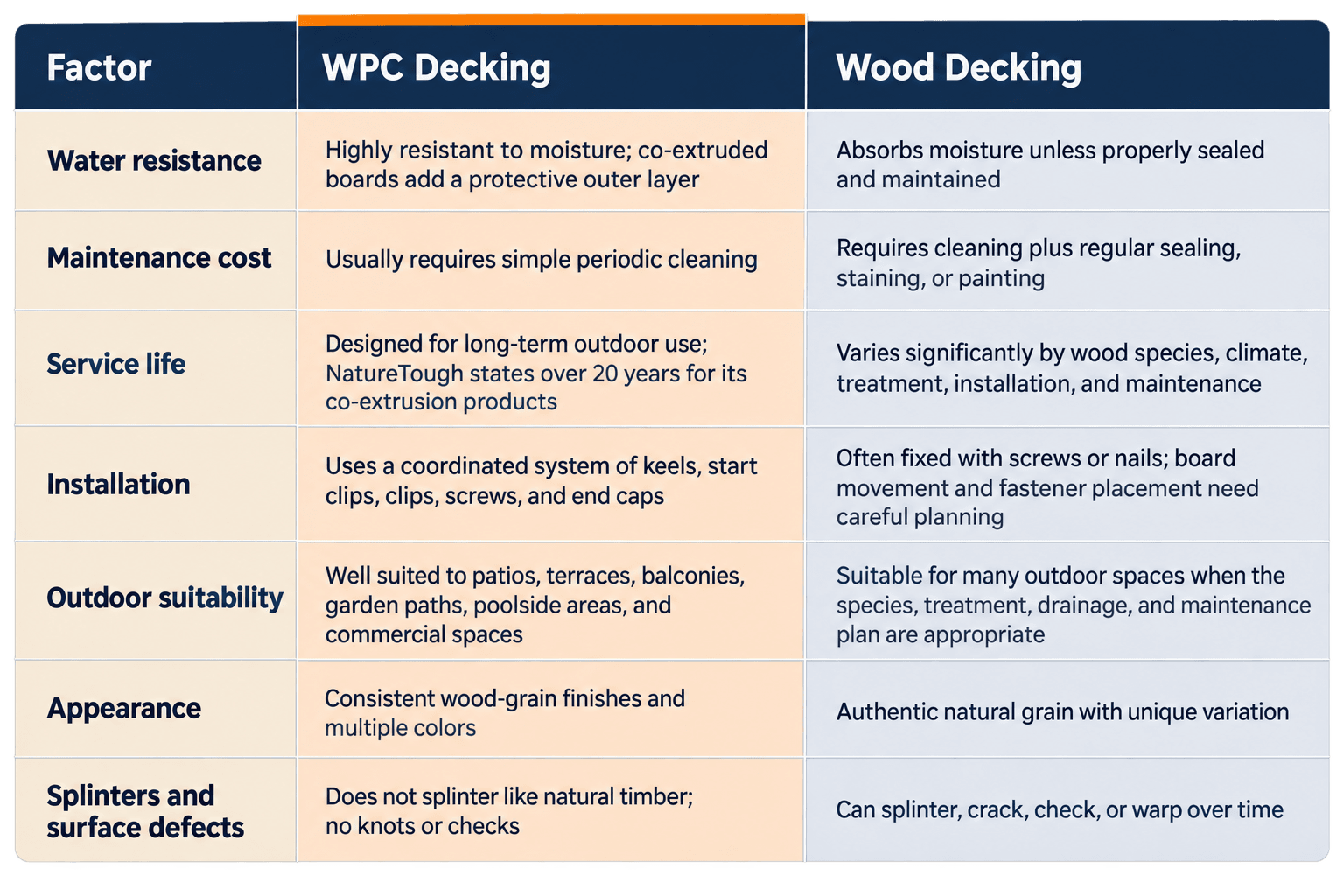
Quick Comparison: WPC Decking vs Wood Decking
1.Water Resistance
Water is one of the most important considerations for any outdoor deck. Rain, humidity, splash water, and poor drainage can all affect long-term performance.
- WPC Decking
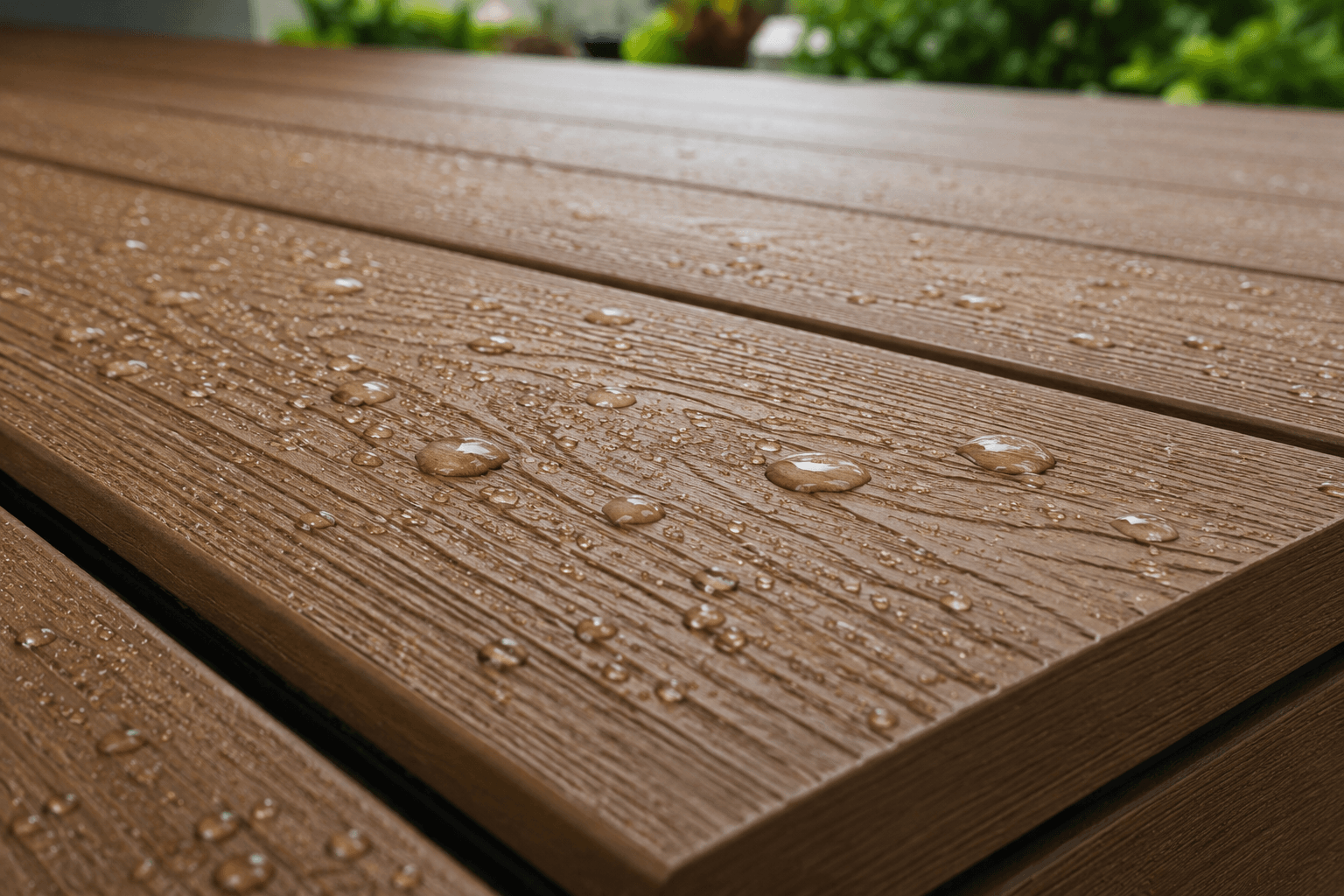
WPC decking combines wood fiber with polymer materials. Unlike untreated natural wood, it is engineered to resist moisture absorption and the problems that often follow, including swelling, rot, and mildew-related deterioration.
Co-extrusion decking adds another level of protection. A protective surface layer surrounds the core and improves resistance to moisture, stains, scratches, and weather exposure. This makes WPC especially useful in humid climates and moisture-prone areas.
However, “waterproof” does not mean that installation details can be ignored. The substructure still needs a firm, level base, appropriate drainage, correct board spacing, and airflow. Standing water should always be avoided.
- Wood Decking
Natural wood can absorb and release moisture as outdoor conditions change. Without suitable treatment and maintenance, repeated wetting and drying may contribute to swelling, shrinking, cracking, warping, surface checking, or decay.
Some hardwoods and treated woods perform better outdoors than others, but even durable timber benefits from good drainage, ventilation, correct fastener selection, and regular surface protection.
Better choice for wet or humid areas: WPC decking.
2.Maintenance Cost
The purchase price is only one part of decking cost. Owners should also consider cleaning products, coatings, tools, labor, repairs, and the time required over the life of the deck.
- WPC Decking
WPC decking generally needs only routine cleaning. Dust, leaves, and loose dirt can be removed with a broom, while most everyday marks can be cleaned with water and a mild cleaning solution suitable for the product.
It does not normally require sanding, staining, painting, or annual sealing. This can reduce ongoing labor and maintenance expenses, especially for larger residential developments, hospitality projects, and commercial outdoor areas.
- Wood Decking
Wood decking needs a more active maintenance program. Depending on the wood species, finish, exposure, and climate, maintenance may include:
- Regular sweeping and washing
- Inspection for loose fasteners, splinters, cracks, or decay
- Periodic sanding
- Reapplication of stain, oil, paint, or water-repellent sealer
- Replacement of damaged or deteriorated boards
Natural wood may have a lower initial material cost in some markets, but repeated maintenance can make its long-term ownership cost less predictable.
Better choice for lower routine maintenance: WPC decking.
3.Service Life
Decking lifespan depends on product quality, climate, installation, usage, maintenance, and the condition of the supporting structure.
- WPC Decking
Quality WPC decking is designed to resist moisture, corrosion, insects, wear, and weather-related damage. NatureTough’s co-extrusion system uses a high-performance protective shield and is presented for long-term outdoor use, with a stated lifespan of over 20 years.
Actual service life still depends on correct installation and care. Drainage, expansion gaps, joist spacing, ventilation, and compatible accessories all play an important role.
-
Wood Decking
There is no single lifespan for wood decking. A properly installed and maintained durable hardwood or pressure-treated deck may perform for many years, while untreated or poorly maintained timber in a wet environment may deteriorate much sooner.
Wood also changes naturally as it ages. Color fading, checking, small cracks, and surface weathering may occur even when the deck remains structurally usable. Some owners appreciate this natural patina; others prefer a more consistent appearance.
Better choice for predictable long-term performance with less upkeep: WPC decking.
4.Installation Method
Both WPC and wood decking require a stable substructure. The key differences are in board movement, fastening systems, spacing, and finishing details.
-
How WPC Decking Is Installed
NatureTough WPC decking uses a complete accessory system that includes keels, expansion screws, start clips, locking clips, standard clips, screws, and end caps. A typical installation follows these steps:
- Measure the installation area and mark the layout.
- Prepare a clean, flat base with suitable drainage.
- Position the keels perpendicular to the direction of the decking boards.
- Pre-drill and secure the keels with expansion screws.
- Fix the start clips and align the first board.
- Insert clips into the board grooves and fasten them to the keels.
- Install the remaining boards in sequence while maintaining the specified gaps.
- Secure the end caps or fascia components to finish the edges.
The clip-based system helps create a clean surface with fewer visible fasteners. WPC boards must not be installed exactly like solid timber: installers should follow the product-specific requirements for expansion gaps, keel spacing, edge clearances, drainage, and ventilation.
-
How Wood Decking Is Installed
Wood decking is commonly fixed directly to timber or metal joists using approved screws, nails, or concealed fasteners. Installers must account for wood movement, board moisture content, end sealing where required, fastener corrosion resistance, and the risk of splitting near board ends.
Wood can be cut and worked with familiar carpentry tools, which many installers value. However, boards may vary in straightness, grain, knots, and moisture content, requiring more on-site selection and adjustment.
Which is easier? WPC offers a systematic, repeatable installation with coordinated accessories, while wood offers familiar carpentry methods. In both cases, professional installation is recommended for structural decks or projects subject to local building codes.
5. Outdoor Suitability
Patios and Terraces
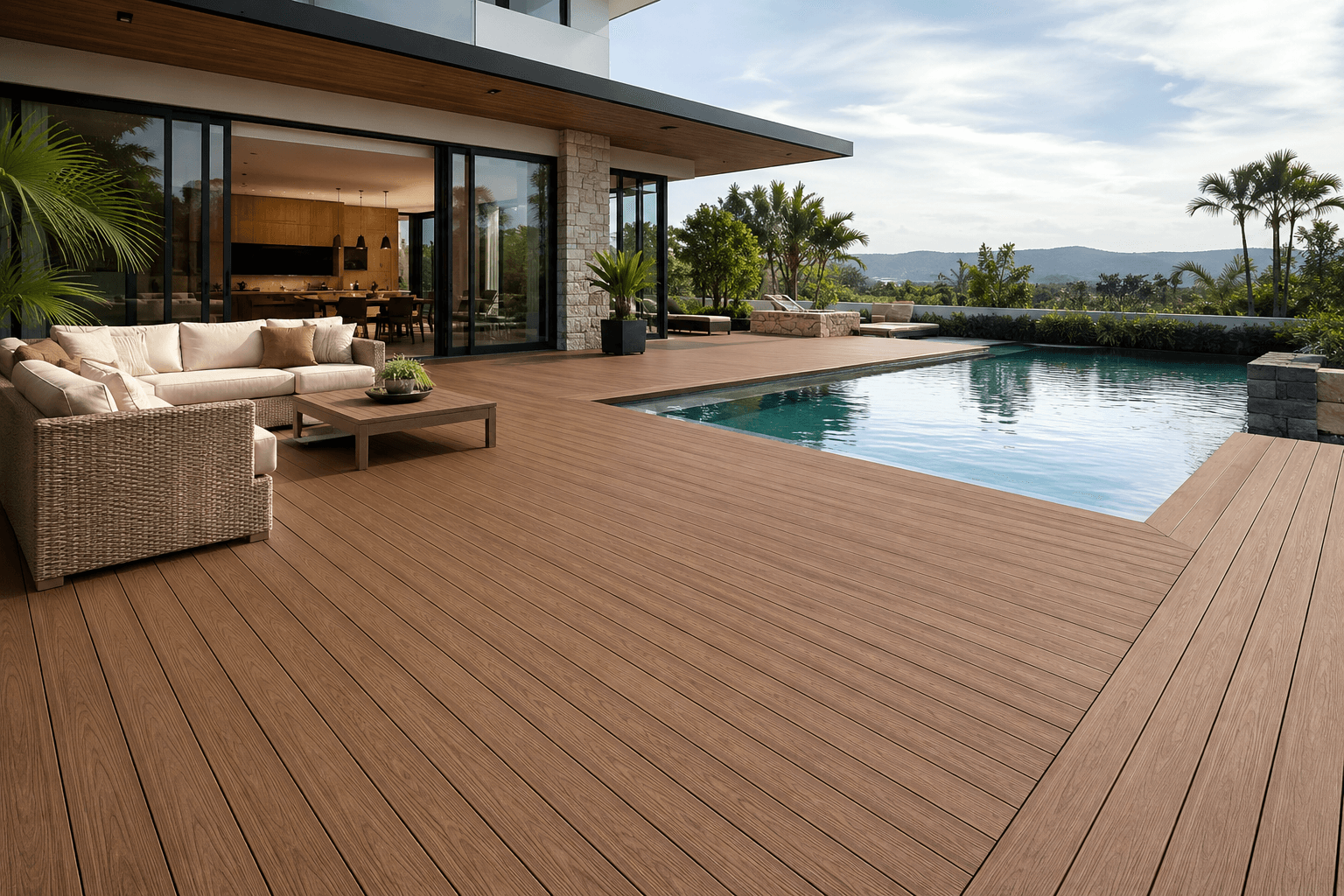
WPC decking is a strong all-around option for patios and terraces because it combines a wood-look surface with low maintenance and good weather resistance. Wood remains attractive where authentic timber character is the main design goal and regular refinishing is acceptable.
Poolside Areas
Moisture resistance makes WPC a practical option around pools. NatureTough profiles include anti-slip surface designs, and certain products are described for poolside and moisture-prone environments. Product selection still matters: check the slip-resistance specification, maintain drainage, and remember that any outdoor surface may become slippery when wet or contaminated.
Balconies and Rooftops
WPC can work well for balconies and rooftop terraces when the supporting structure, allowable load, waterproofing membrane, drainage, and fixing method have been professionally evaluated. Never fasten through a waterproofing system without an approved detail.
Commercial Outdoor Spaces
For restaurants, hotels, resorts, walkways, and public-facing areas, reduced maintenance downtime and consistent appearance can make WPC especially valuable. The selected profile must meet the project’s structural, fire, slip, loading, and local code requirements.
Appearance and Design Flexibility
Natural wood is difficult to match when the goal is completely authentic grain, knots, and variation. It can also be sanded and refinished in a different color.
WPC decking offers more consistent color and surface texture from board to board. NatureTough provides both extrusion and co-extrusion decking, multiple profiles, wood-grain and brushed surface treatments, and colors ranging from light wood and grey to teak, dark coffee, rosewood, and black. This makes it easier to coordinate decking with wall cladding, fencing, columns, and other outdoor materials.
Which Decking Should You Choose?
Choose WPC decking if your priorities include:
- Strong resistance to moisture and changing weather
- Minimal routine maintenance
- Long-term color and surface consistency
- No splinters and fewer natural defects
- A concealed clip-based installation system
- Coordinated colors, profiles, and outdoor product solutions
Final Verdict
There is no universal decking material for every project. Natural wood offers authentic beauty and can be an excellent choice when it is correctly specified, installed, and maintained.
For many modern outdoor projects, however, WPC decking provides the better balance of water resistance, low maintenance cost, long service life, installation efficiency, and year-round outdoor suitability. It is particularly attractive for patios, terraces, poolside spaces, balconies, garden areas, and commercial projects where reliable performance and easier upkeep are important.
NatureTough WPC decking combines wood-inspired finishes with extrusion and co-extrusion technology, multiple profile options, and a complete accessory system. Explore the NatureTough decking collection, review the decking installation guide, or contact NatureTough to discuss profiles, colors, samples, and project requirements.
FAQ-Frequently Asked Questions
1. Is WPC decking completely waterproof?
WPC decking is highly resistant to water absorption and is marketed by NatureTough as waterproof. Correct drainage, spacing, ventilation, and substructure design are still essential because water can collect around or beneath any deck.
2. Does WPC decking need to be sealed or painted?
WPC decking does not normally require sanding, staining, painting, or annual sealing. Follow the manufacturer’s cleaning and care instructions for the selected product.
3. Does WPC decking get hot in direct sunlight?
Like wood, stone, and other outdoor surfaces, WPC can become hot in strong sunlight. Dark colors generally absorb more heat than light colors. Consider local climate, shade, color, board location, and a physical sample before specification.
4. Can WPC decking be installed over concrete?
It can often be installed above a suitable concrete base using the specified keel system, provided the surface is stable, level, and properly drained. Follow the installation guide and do not block drainage paths.
5. Is WPC decking suitable around swimming pools?
Yes, suitable WPC profiles can be used in poolside environments because of their moisture resistance and anti-slip surface options. Confirm the slip-resistance requirements for the project and maintain the surface regularly.