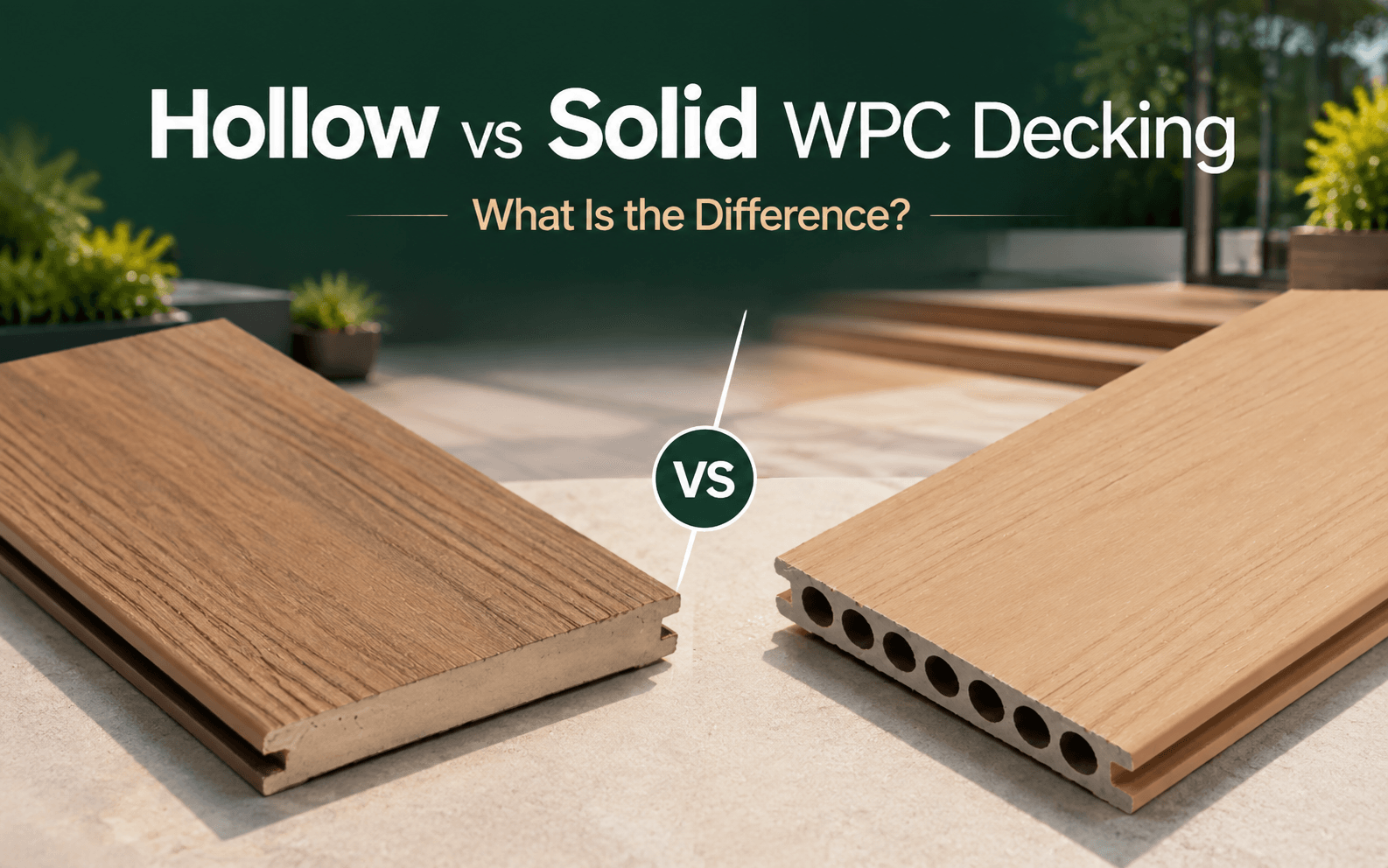
Hollow vs Solid WPC Decking: What Is the Difference?
25th August, 2026When choosing WPC decking, buyers often compare hollow and solid profiles. Both are manufactured from a mixture of wood fiber, recycled plastic, and performance additives, but their internal structures create important differences in weight, strength, cost, and application.
The right choice should not be based on appearance alone. Project type, substructure spacing, expected load, climate, and installation requirements must also be considered.
What Is Hollow WPC Decking?
Hollow WPC decking contains one or more internal cavities running through the board. These cavities reduce material usage and make the decking lighter.
Its main advantages include:
- Lower board weight
- Easier handling and transportation
- More economical material cost
- Faster installation for residential projects
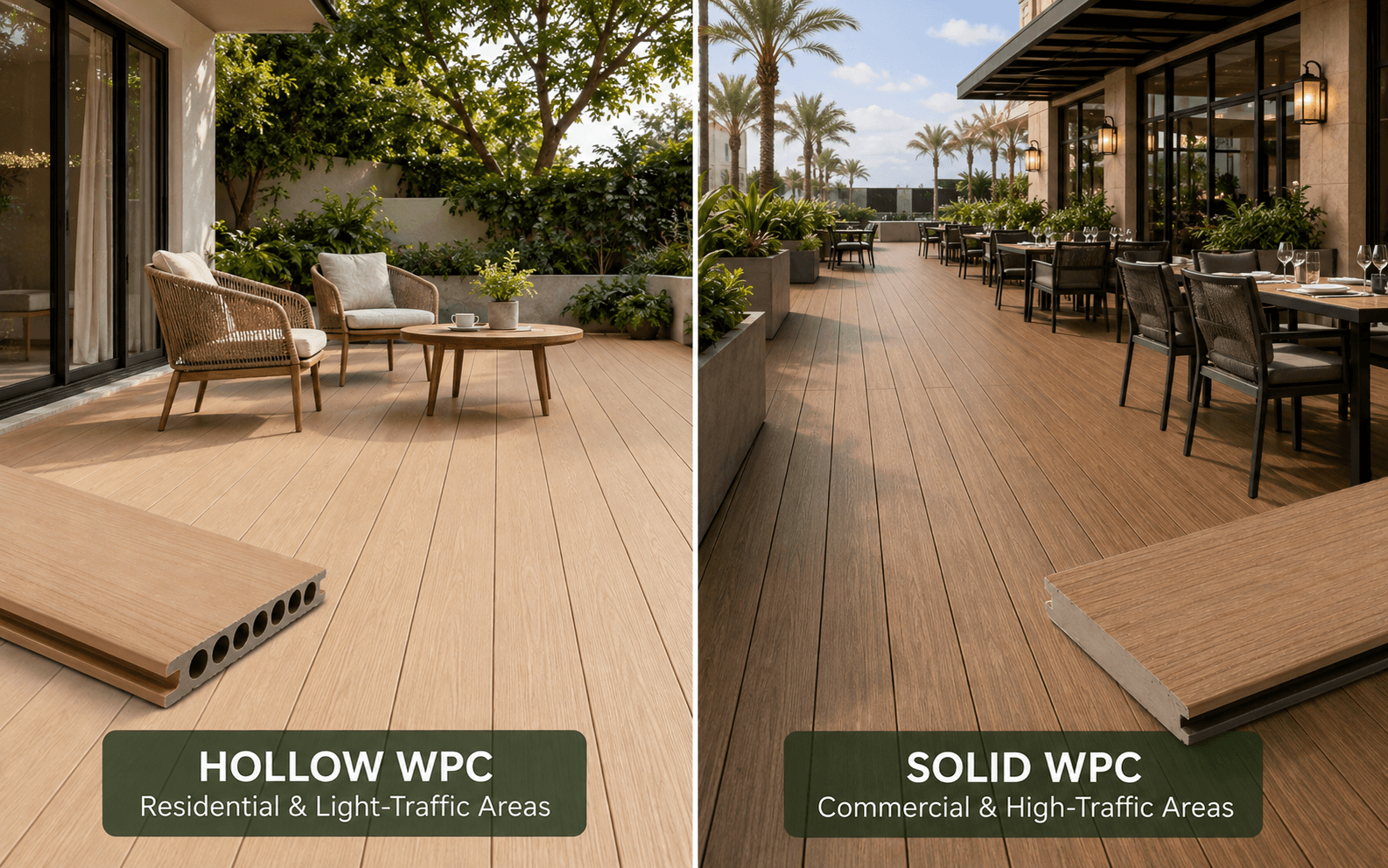
Hollow decking is commonly used for residential balconies, private gardens, patios, walkways, and other light- to medium-traffic areas.
However, the hollow structure requires careful installation. Board ends should normally be protected with end caps or finishing profiles, and the joist spacing must follow the manufacturer’s instructions. Unsupported ends or incorrect spacing may reduce long-term stability.
What Is Solid WPC Decking?
Solid WPC decking has a full internal structure without large cavities. It generally contains more material, making the board heavier and more rigid.
Its main advantages include:
- Higher resistance to concentrated loads
- Better rigidity under heavy foot traffic
- Greater suitability for commercial applications
- More flexibility when cutting or shaping board ends
Solid decking is often selected for hotels, restaurants, public walkways, commercial terraces, swimming pool areas, and projects where higher structural performance is required.
Because it uses more raw material, solid WPC decking is usually heavier and more expensive than a comparable hollow profile. Transportation and installation costs may therefore be higher.
Hollow vs Solid WPC Decking Comparison
| Factor | Hollow WPC Decking | Solid WPC Decking |
|---|---|---|
| Internal Structure | Contains internal cavities | Full-core construction |
| Weight | Lighter | Heavier |
| Cost | Usually more economical | Usually higher |
| Load Resistance | Suitable for residential use | Better for heavier loads |
| Transportation | Lower shipping weight | Higher shipping weight |
| Typical Application | Balconies, gardens and patios | Commercial and high-traffic projects |
Is Solid WPC Decking Always Stronger?
Not necessarily.
The performance of WPC decking depends on more than whether the profile is hollow or solid. Raw-material formulation, wall thickness, cavity design, board dimensions, manufacturing quality, and joist spacing can all affect the final result.
A well-engineered hollow board may perform better than a low-quality solid board. Buyers should therefore compare verified test data instead of judging products only by weight or profile type.
Important performance indicators include:
- Flexural strength and stiffness
- Maximum recommended load
- Water absorption
- Slip resistance
- Thermal expansion
- Weathering resistance
- Recommended joist spacing
For regulated projects, buyers can also request test reports based on relevant standards, such as EN 15534 for wood-plastic composite decking in Europe or ASTM D7032 for wood-plastic composite decking systems in North America.
Which WPC Decking Should You Choose?
Choose hollow WPC decking when the project requires a lighter, cost-effective solution for residential or moderate-traffic use.
Choose solid WPC decking when the project involves heavier loads, frequent commercial traffic, exposed board ends, or higher structural requirements.
For distributors and project buyers, the best decision should balance product performance with transportation cost, installation conditions, and target market positioning.
Final Recommendation
There is no single profile suitable for every project. Hollow WPC decking offers advantages in weight, handling, and cost, while solid WPC decking provides greater rigidity and is generally preferred for demanding applications.
Before placing an order, confirm the project load, joist spacing, installation environment, and required testing standards with the supplier. This ensures that the selected WPC decking delivers reliable performance throughout its service life.